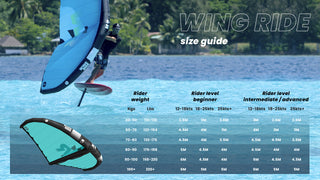
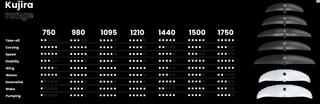
Rarely has a watersport come along and caused such a stir so quickly. Wingfoiling is an incredible bridge between kiting, windsurfing and surf foiling that appeals to a broader section of new watersports participants because of its simplicity, quick learning curve, location suitability and safety. As wingfoiling continues to grow in popularity, we have made notable functionality improvements to our wing offering to adapt to the advancement of the sport. These enhancements will really up your riding game.
Foiling is still relatively new to many and it can take a while to wrap your head around the multiple variables involved. It doesn’t matter if you are a complete newbie or already a foil veteran, sometimes it can be a real dilemma to choose between so many different foil wings.
But don’t despair just yet, we are here to help you out.
Basics
Let’s start with some basics that you should consider before getting a foil.
Having already some experience in surfing, windsurfing or kitesurfing is a great advantage when starting to foil, as it already gives you some knowledge on positioning and balance.
Foiling requires more accuracy in terms of the positioning of your body and feet and is less forgiving when it comes to mistakes. In case you are totally new to the sport, we recommend taking lessons with an instructor, as this will help you to progress faster, safer and prevent demotivation due to slow progress.
Keep in mind that your weight is an important factor when choosing a foil, the heavier you are the easier it is to ride on a bigger foil. Especially when beginning you want to go for bigger and more stable foils, that allow you to progress. As your skills improve you can start to foiling on smaller and more manoeuvrable foils.
Side note: for more "How to" content, check out our Youtube channel.
Before you start, you should get to know the different elements. A foil is made up of separate parts:
A front wingA back wing also called the stabiliser or 'stab' for shortA fuselage that connects the two wingsA mast and top plate that connects all the parts to the board.
Long fuselage vs. short fuselage
The length of the fuselage also has an impact on stability and performance.
A longer fuselage will lend more stability while a shorter fuselage will bring the front wing closer to the stab and thus will allow for more manoeuvrability and it will bring much more dynamism in the pumping and in the handling.
Your level will determine the length of the foil mast you choose. The size of the mast can vary between 40cm and over 1m.
Keep in mind that the shorter the mast is, the easier it will be to start, given that a shorter mast stays closer to the surface of the water. So when starting, we recommend you choose a mast of about 65 cm. It is a perfect length for beginners as it will allow you to handle small waves and also means you won't need to look for a spot with very deep water.
If you already feel comfortable on a shorter mast you can start improving your skills with a 75 cm or 85 cm mast.
Surface Area
The surface area is commonly measured as the projected surface area in square centimetres and is the main indicator of lift the foil will generate. If you hold a torch/light over the foil, the projected area is the area of the shadow projected by the wing.
Profile
While thicker profiles are designed to generate more lift at lower speeds and are more forgiving during the flight, foils with thinner profiles are much more sensitive and take more skill to use, however once mastered they generate less drag and allow for higher speeds and more manoeuvrability.
High aspect vs. low aspect foils
The aspect ratio of a foil is the ratio of its span to its mean chord. It is equal to the square of the wingspan divided by the wing area. High aspect ratio foils generate less drag and allow for an endless glide, however, they need higher speeds than low aspect ratio wings to take off and avoid stalling.
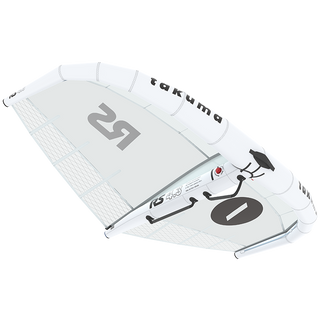
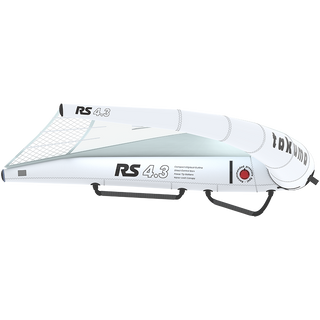
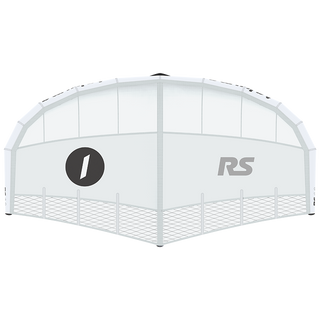
TAKMUMA RS WING 5.1
- Unit price
- /per
A masterpiece of aerodynamism, Wing 2.0.
No need to over sheet-in the RS, unlike other wings, the RS is not on-off. It just flies on its own.
Once your hands are into position, it will do the job.
The RS is the most balanced, neutral and stable freefly wing ever designed.
The control of the profile guarantees unforgettable sessions.
If you are looking for a performance freeride with comfort, long surf or downwind surf, the RS is for you.
You do not need to think about the wing, you only have to focus on your trajectory and your foil.
The RS is always well positioned, once the profile is locked, it is predictable and gives a sensational feeling of stability.
Super-efficient in pumping, the RS will make you fly early and its forward-pull lifting force will get you going in light winds.
As the wind picks up, the RS keeps pulling forward while remaining remains neutral and delivering progressive accelerations without losing speed.
The RS was not designed for experts only, it is suitable for everyone and will allow you to progress at a fast pace, giving you the confidence to improve from your first downwind surf to your first jumps.
FEATURES
• Angular carbon handles
Takuma’s signature carbon fiber handle is designed to provide the rider with a more ergonomic handling and natural body positioning.
These ultra-stiff handles offer a quick response steering and a direct connection to the wing. Upwind performance and power delivery are optimized.
The raised angle of the front handle combined with an oval grip offer a perfect wrist position for more comfort and maneuverability, creating an axe of rotation during maneuvers.
The wing can be kept higher, easy to bring over your head, and further away from the body, in turn improving sailing trim when in ‘switch’ position.
As the wing naturally pivots in the hand and is easy to pass from one hand to the other, making it super nice to hold during the surf.
The long rear handle is purposely positioned parallel to the strut to allow for natural hand adjustment, by intuitively sliding along the handle instead of having to switch between loops.
Our handle design successfully reduces arm pressure during freefly, offer great grip during jumps and full control during surf. No inertia nor delays when engaging maneuvers, the drive of the wing is always efficient.
• Power tip battens
Provide extra tension making the tips much stiffer and resistant to collapsing when under pressure.
The Power tip battens extend the wind range usage of each wind increasing the rigidity of the profile and leading edge resistance to torsion.
• X-Ply Plus
Latest generation of stretch resistant double rip-stop laminate on the trailing edge panels that prevents profile deformation.
Thick and durable trailing edge is essential as tensions are important and the resistance provided prolongs the wing lifespan.
• Mini leech battens
Lightweight mini battens prevents the leech to twist and avoid detrimental leech flutter.
They maximize the trailing edge stability and extend the longevity of the wing.
• Nano coated canopy
Ultra-resistant against stretching, this featherlight high density material can carry all loads and adapt to extreme tensions.
Nano-X Coated Canopy offers the best resistance to elongation, and allows the wing to keep its shape through time.
• Twin Valve system
2 independent valves that allow for a better control of the leading edge and strut pressure.
Our valves offer a high flow connection for any easy and super-fast inflation and deflation.
No screwing necessary, our pump adaptor just fits into the valve, simple.
The most efficient and reliable system in the market.
Too much sun can modify the color
protect your board from strong impacts
Adding product to your cart
Rarely has a watersport come along and caused such a stir so quickly. Wingfoiling is an incredible bridge between kiting, windsurfing and surf foiling that appeals to a broader section of new watersports participants because of its simplicity, quick learning curve, location suitability and safety. As wingfoiling continues to grow in popularity, we have made notable functionality improvements to our wing offering to adapt to the advancement of the sport. These enhancements will really up your riding game.
Foiling is still relatively new to many and it can take a while to wrap your head around the multiple variables involved. It doesn’t matter if you are a complete newbie or already a foil veteran, sometimes it can be a real dilemma to choose between so many different foil wings.
But don’t despair just yet, we are here to help you out.
Basics
Let’s start with some basics that you should consider before getting a foil.
Having already some experience in surfing, windsurfing or kitesurfing is a great advantage when starting to foil, as it already gives you some knowledge on positioning and balance.
Foiling requires more accuracy in terms of the positioning of your body and feet and is less forgiving when it comes to mistakes. In case you are totally new to the sport, we recommend taking lessons with an instructor, as this will help you to progress faster, safer and prevent demotivation due to slow progress.
Keep in mind that your weight is an important factor when choosing a foil, the heavier you are the easier it is to ride on a bigger foil. Especially when beginning you want to go for bigger and more stable foils, that allow you to progress. As your skills improve you can start to foiling on smaller and more manoeuvrable foils.
Side note: for more "How to" content, check out our Youtube channel.
Before you start, you should get to know the different elements. A foil is made up of separate parts:
A front wingA back wing also called the stabiliser or 'stab' for shortA fuselage that connects the two wingsA mast and top plate that connects all the parts to the board.
Long fuselage vs. short fuselage
The length of the fuselage also has an impact on stability and performance.
A longer fuselage will lend more stability while a shorter fuselage will bring the front wing closer to the stab and thus will allow for more manoeuvrability and it will bring much more dynamism in the pumping and in the handling.
Your level will determine the length of the foil mast you choose. The size of the mast can vary between 40cm and over 1m.
Keep in mind that the shorter the mast is, the easier it will be to start, given that a shorter mast stays closer to the surface of the water. So when starting, we recommend you choose a mast of about 65 cm. It is a perfect length for beginners as it will allow you to handle small waves and also means you won't need to look for a spot with very deep water.
If you already feel comfortable on a shorter mast you can start improving your skills with a 75 cm or 85 cm mast.
Surface Area
The surface area is commonly measured as the projected surface area in square centimetres and is the main indicator of lift the foil will generate. If you hold a torch/light over the foil, the projected area is the area of the shadow projected by the wing.
Profile
While thicker profiles are designed to generate more lift at lower speeds and are more forgiving during the flight, foils with thinner profiles are much more sensitive and take more skill to use, however once mastered they generate less drag and allow for higher speeds and more manoeuvrability.
High aspect vs. low aspect foils
The aspect ratio of a foil is the ratio of its span to its mean chord. It is equal to the square of the wingspan divided by the wing area. High aspect ratio foils generate less drag and allow for an endless glide, however, they need higher speeds than low aspect ratio wings to take off and avoid stalling.